
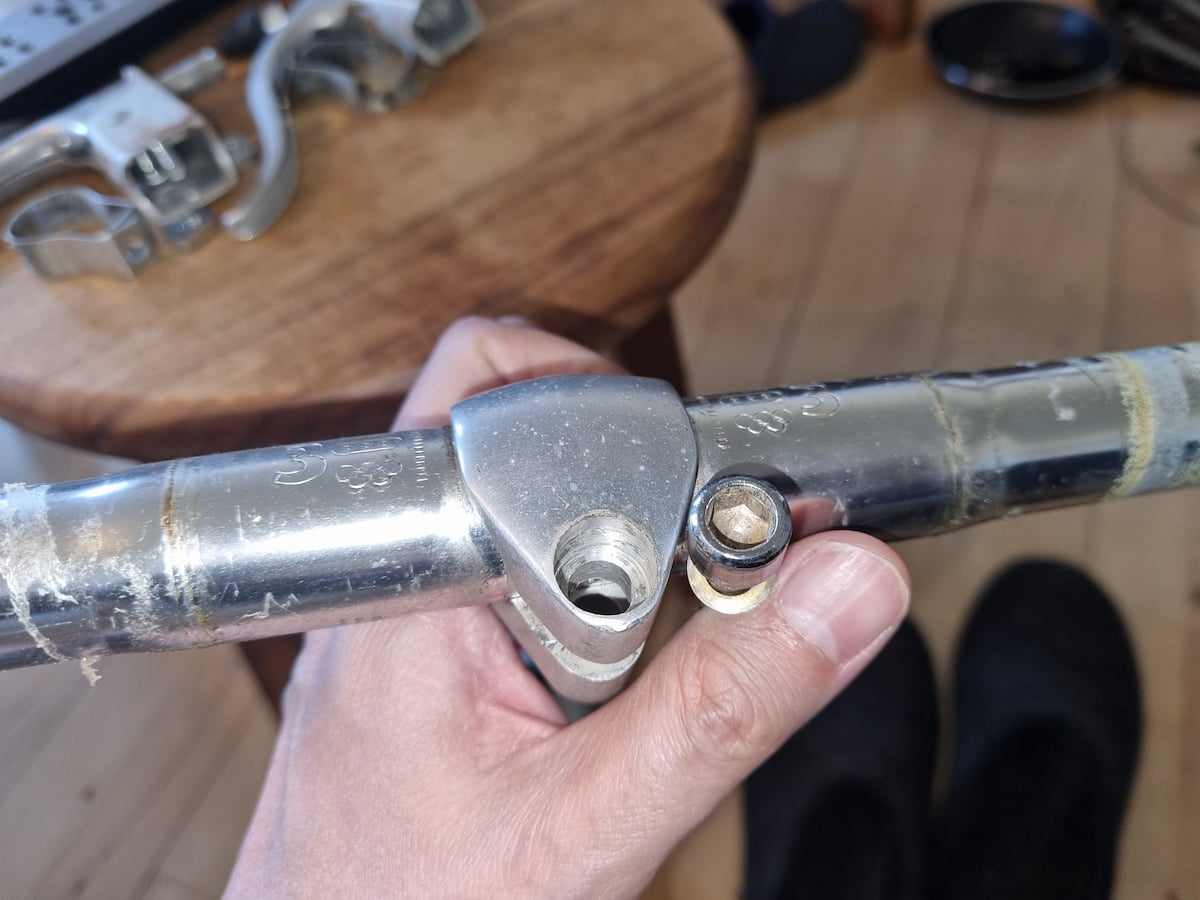
It gets confusing when you come across a hex (“Allen”) bolt that is just too big for a 6 mm, and too small for an 8 mm hex key – and the 9/32″ just doesn’t fit right. Yes, there are imperial standard bolts, but there is also a 7 mm hex bolt. Very rare, but it exists. How can you tell?
7 mm or imperial?
Today, 7 mm hex is very uncommon: 6 mm and 8 mm are the current standard and most often used – by far. So it makes sense to check if you are in fact dealing with an imperial standard bolt or a real 7 mm.
The closest imperial standard is 9/32 inch ~ 7.144 mm. Imperial 9/32″ tool might fit some 7 mm hex bolts – depending on the exact manufacturing size of the tool and the bolt – since those always differ from the nominal sizes a bit. However, there is a higher risk of damaging the bolt and the tool for improper fit when doing so, and I would not advise that. So, to repeat:
Don’t mix 7 mm, and 9/32″, because that can strip the bolt’s head or damage the tool.
To identify which standard you’re dealing with, check the origin:
| Origin | Likely standard |
|---|---|
| US, UK – especially pre 1980 | 9/32″ hex (~ 7.14 mm) |
| Germany, France, Italy – especially pre 2000 | 7 mm hex |
- Imperial standard (9/32″) is used on US or UK based machines.
Older (“classic”) US & UK cars & motorcycles (pre 1980 roughly), US & UK lawnmowers, firearms, and some tools. - Metric standard (7 mm) is used on continental European machines.
Mostly German, French, and Italian cars and bicycle parts – see sections below for more details.
Measure
One good measurement beats a thousand expert opinions. So, while the above-stated info can help, it is best to double-check with some calipers. Measure the flat-to-flat distance.
| Standard / nominal size | Caliper reading (flat to flat) |
|---|---|
| Imperial 9/32″ ~ 7.14 mm | 7.10 ~ 7.20 mm |
| Metric 7 mm | 6.95 ~ 7.05 mm |
Manufacturing tolerances vary, but:
- If it reads below 7.05 mm, it is the 7 mm metric hex.
- If it reads over 7.10, it is the 9/32″ imperial hex.
7 mm hex (“Allen”) key bolt cycling related examples
Here are some practical examples where 7 mm hex bolts were used by the manufacturer.
- Older Campagnolo square taper cranks (Record, Chorus, etc.) for the crank arm fixing bolts.
- 3TTT quill stems.
- Some parts on French bicycles (older Peugeot bicycles for example).
7 mm hex key in automobile applications
- Some VW Golf, Passat, some Audi, and some BMW models use 7 mm hex bolts on brake caliper pins.
- Certain engine cover bolts and similar are fixed with 7 mm hex bolts, in some German cars.
- HVAC housings or under-dash structures in Renault, Peugeot, or Ford Europe models.
- Some obscure manual gearboxes, especially in Fiat or Alfa Romeo, used 7 mm hex for non-load-critical covers or brackets.
Photo source – this Facebook discussion from the Home Bicycle Mechanics Facebook group.
Last updated:
Originally published:
