
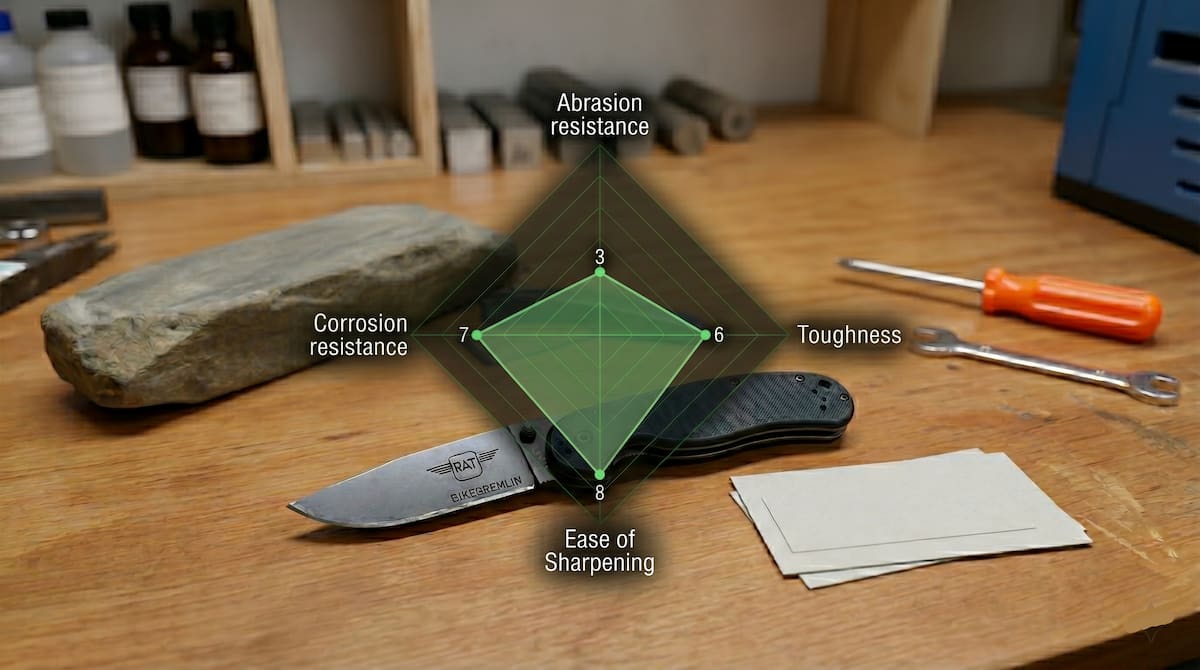
Welcome to the interactive knife steel database. This tool allows you to objectively compare modern and traditional cutlery alloys based on four primary metallurgical attributes: abrasion resistance, toughness, corrosion resistance, and ease of sharpening.
Knife Metallurgy & Maintenance Series:
How to use
- How to use: Click any of the column headers in the legend to instantly sort the database by that specific property.
- Need the theory? If you are unsure what these terms mean in practical use, read this comprehensive Knife Steels 101 guide to understand the physical compromises inherent in metallurgy.
Steel properties
Steel Attributes (Click to Sort)
- Name (A-Z)
- Alphanumeric sorting by steel designation.
- Abrasion Resistance
- How well steel resists friction. Note: Industry charts often use “edge retention” based on CATRA machine tests (sandpaper-like abrasion). In reality, edge failure is often caused by rolling (low toughness) or corrosion.Abrasion resistance is only one facet of true edge retention.
- Toughness
- Resistance to chipping, breaking, or rolling under impact.
- Corrosion Resistance
- Ability to withstand moisture and environmental staining.
- Ease of Sharpening
- How easily the apex can be restored.
A note on heat treatment
Remember that chemical composition is only half the story. A masterfully heat-treated budget steel will often outperform a poorly heat-treated premium “super-steel.” The numbers above represent the potential of the steel when processed correctly.
Blade geometry also plays a massive role in actual cutting performance – a thick edge in a tough steel will cut very differently than a laser-thin edge in a brittle steel (read more about blade geometry here).
Last updated:
Originally published:
